

The MedTech industry is one of the most innovative and unforgiving spaces in healthcare. For every breakthrough device that transforms patient care, countless others never make it past early adoption. Not because the ideas weren’t good, but because the journey from concept to commercialization is complex, nuanced, and often misunderstood.
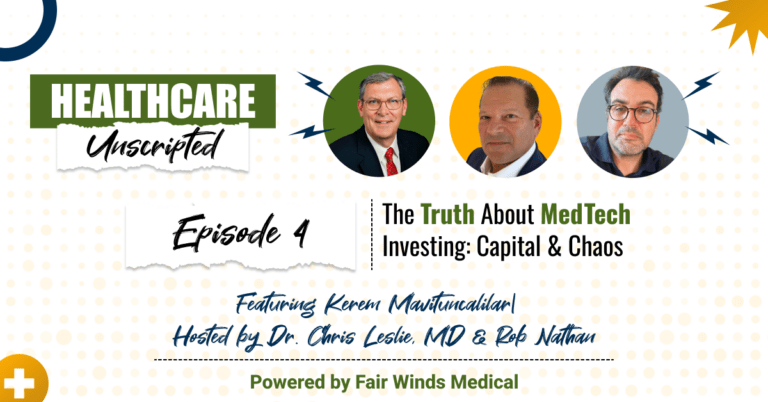
In a recent episode of Healthcare Unscripted, Dr. Chris Leslie sat down with Rob Nathan, Co-Founder and Chairman of Fair Winds Medical, to explore these realities through the lens of someone who has spent more than 30 years evaluating, funding, and guiding healthcare companies. What emerged was a candid and practical roadmap for anyone building, investing in, or supporting medical technologies.
Here’s what we learned.
The Unexpected Origins of Fair Winds Medical
Unlike many companies built from a long-term business plan, Fair Winds Medical emerged from years of experience, relationships, and repeated exposure to the same challenges across early-stage MedTech.
Rob explains that Fair Winds began as a partnership built around shared expertise. As he supported companies through investment banking and Michael Droge worked in commercialization roles, both saw a recurring pattern: promising technologies were failing because innovators lacked the infrastructure, strategy, or leadership to bring them to market.
That gap, between innovation and commercialization, became the foundation of Fair Winds Medical.
“Fair Winds was a complete accident,” Rob says. “It grew out of helping companies that needed both capital and commercialization support and realizing we could offer both.”
Disruptive Technology Isn’t Enough
One of the biggest misconceptions in MedTech is that a great idea is the same thing as a successful company. In reality, the idea is only the beginning.
According to Rob, three elements ultimately determine whether a technology succeeds:
- Leadership — A strong, experienced team that knows how to take a product to market
- Market Direction — Understanding where the industry is heading, not just where it is today
- Distribution — Getting the technology into the hands of clinicians through the right channels
Many founders underestimate the importance of commercialization strategy and distribution. They believe a groundbreaking technology will “sell itself.” It rarely does.
“There’s a graveyard of great technologies that should’ve made it,” Rob notes. “Leadership and execution matter just as much as the idea.”
Why Some MedTech Startups Fail
Rob has reviewed hundreds of MedTech companies throughout his career, and he sees the same mistakes repeated often:
- Unrealistic valuations
Companies that price themselves too high early on struggle to raise capital later. Investors need room to make a return.
- Weak leadership and team structure
A visionary founder may not be the right person to lead the commercialization phase.
- Poor distribution strategy
Without the right training, relationships, and clinical integration, even the best technology will stall.
- Lack of understanding around reimbursement
Revenue models matter. If clinicians can’t get paid for using a device, adoption becomes nearly impossible.
- Failure to adapt
Markets shift. Strategies must shift with them.
It’s not a lack of innovation that stops most companies; it’s the operational and strategic pieces around the innovation.
The Role of Investor Education
One unique angle Rob explores is the perspective of surgeon-investors; clinicians are often approached with investment opportunities but rarely given the education needed to evaluate them effectively.
Surgeons may see a great idea in the OR, but that doesn’t automatically translate to a viable business. Rob encourages clinicians to ask deeper questions:
- What is the actual valuation?
- How many shares are outstanding?
- Is the leadership team experienced?
- What does distribution look like?
- Is the reimbursement pathway clear?
- Are investors holding equity or structured notes?
- Is the company creating accountability for itself?
These questions protect investors and force startups to be intentional about how they grow.
Why Distribution Is the Hidden Key to Adoption
Fair Winds Medical is built on the belief that distribution is not merely a logistical function; it’s a clinical one. For surgeon-driven technologies, distribution connects the innovation to its real-world users.
A strong distribution network:
- Trains clinicians
- Aligns products with workflow
- Ensures availability in ORs
- Provides real-time feedback
- Facilitates early adoption
- Builds credibility in key markets
This ecosystem is what many early-stage companies lack, and Fair Winds’ network has become a cornerstone of its success.
Timing the Exit: How and When Companies Should Think Ahead
Every MedTech founder dreams of a successful exit, but the timeline is rarely linear. Rob advises companies to:
- Build the business for long-term sustainability
- Demonstrate traction before fundraising aggressively
- Show evidence, not just a plan
- Understand that the right partner will appear when milestones are met, not when founders feel “ready”
Exit timing is a combination of performance, market conditions, and strategic alignment—not a date on a calendar.
Fair Winds Medical’s Future
Looking ahead, Rob sees Fair Winds remaining deeply committed to the disruptive technologies that inspired its founding. The company continues to be selective, choosing innovations that align with its expertise and can benefit from its commercialization infrastructure.
“We’re a family,” Rob says. “A team of seasoned people who are here because they want to be. As long as we can attract great talent and maintain bandwidth, we’ll keep helping meaningful technologies reach the market.”
Final Thoughts
MedTech innovation isn’t just about the device. It’s about structure, leadership, valuation, distribution, and execution.
This episode of Healthcare Unscripted provides a rare and transparent look at how great ideas become great companies and why so many struggle along the way.
For surgeons, founders, investors, and anyone in the MedTech ecosystem, Rob Nathan’s insights offer the kind of clarity that can change the trajectory of a project, a company, or a career.
Listen to the full episode here: YouTube